Trinidad and Tobago | August 4, 2026
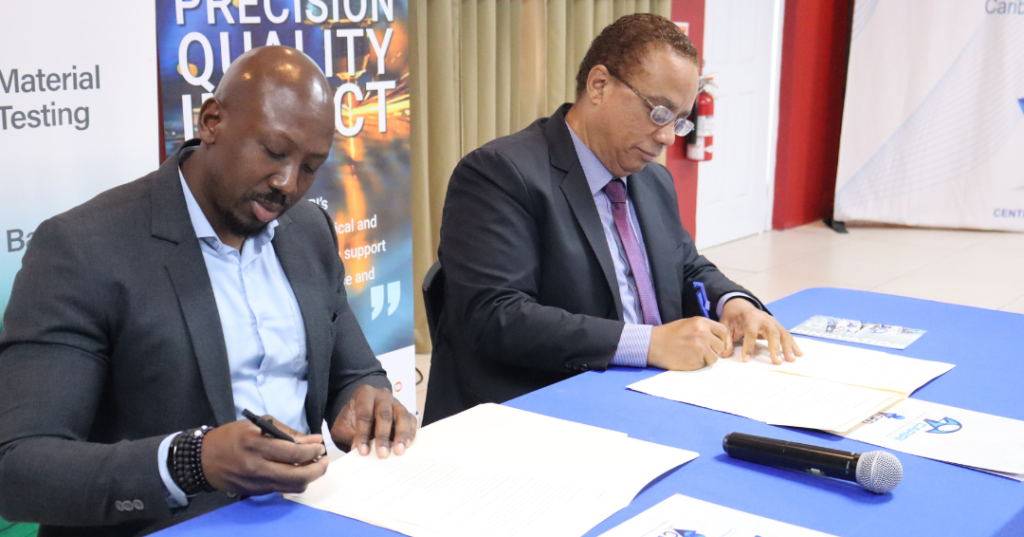
The Caribbean Industrial Research Institute (CARIRI) and Studley Park Enterprise Limited (SPEL) have officially signed a Memorandum of Understanding (MOU) to begin a strategic collaboration to advance research, innovation, and the commercialization of sustainable infrastructure solutions in Tobago on 4th August 2026 at CARIRI’s Centre for Enterprise Development, Innovation Avenue, Freeport.
The agreement, signed by CARIRI's Chief Executive Officer, Mr. Hans-Erich Schulz, and SPEL's Director, Dr. Christian Virgil, establishes a framework for collaboration in research, technical consultancy, technology transfer, and product development. The partnership will initially focus on the development and application of rubberized asphalt using recycled tyre rubber, with opportunities to expand into other commercially viable research and innovation initiatives.
The signing follows months of technical collaboration between the two organizations. Earlier engagements included CARIRI's visit to the Studley Park Quarry in Tobago to assess operational requirements and identify practical opportunities for innovation. CARIRI subsequently supplied rubber crumb produced at its state-of-the-art facility for incorporation into asphalt mixtures that were successfully tested on roads in Tobago. The positive outcomes demonstrated the material's performance under Tobago's environmental and operational conditions and laid the groundwork for formalizing the partnership.
Speaking on the significance of the collaboration, CARIRI Chief Executive Officer Hans-Erich Schulz said: “Our role extends beyond producing rubber crumb. We provide the scientific expertise, technical consultancy, testing, and knowledge transfer needed to help organizations move successfully from concept to implementation. Every environment presents unique challenges, and our approach is always to understand those conditions and develop solutions that are fit for purpose.
The successful testing of rubber crumb in both Trinidad and Tobago gives us greater confidence in the technology and its potential for wider application. It demonstrates that innovative, sustainable solutions can be adapted to different operating environments and provides a strong foundation for expanding the use of rubberized asphalt throughout Trinidad and Tobago and, with appropriate testing, across the Caribbean."
Dr. Christian Virgil, Director of Studley Park Enterprise Limited (SPEL), commented, "This partnership represents an important opportunity to evaluate an innovative solution that has the potential to benefit Tobago's infrastructure and environment. Our priority is to ensure that the technology is thoroughly tested and proven before moving to wider implementation. The early findings are promising, and we see significant potential for rubberized asphalt to improve the longevity of our roads while supporting sustainable waste management.
Our long-term vision is to incorporate rubberized asphalt into road paving projects across Tobago and, ultimately, establish a local rubber crumb production capability that transforms waste tyres into a valuable resource while creating new economic opportunities for the island. This collaboration with CARIRI is an important step toward developing local capabilities that can deliver lasting environmental, economic, and infrastructure benefits for Tobago."
Under future project-specific agreements, CARIRI is expected to provide technical consultancy to support SPEL in planning and establishing a rubber crumb production facility in Tobago. This support may include technical assessments, plant and process advisory services, materials testing, product development, quality assurance, operational systems development, and capacity building.
The collaboration also represents an important step toward strengthening the circular economy by transforming end-of-life tyres into valuable raw materials for road construction and other industrial applications. CARIRI's rubber crumb production process diverts waste tyres from landfills and converts them into commercially useful products that contribute to environmental sustainability while supporting economic development.
While rubberized asphalt represents the initial focus, the MOU establishes a broader platform through which CARIRI and SPEL can pursue future initiatives in construction materials research, quarry by-product utilization, process innovation, technical training, testing, consultancy services, and commercialization.